This is the fourth (and final) in a series of blog posts I wrote for the Project on Lived Theologyon my two-week lived theology road trip from New Orleans to Memphis. To read more of my posts, click here.
From Jackson I drove north to Oxford, home of the University of Mississippi and a number of my old friends. That Wednesday evening, I slide in to a pew at the back of the campus chapel for the weekly gathering of the Reformed University Fellowship (RUF). The new chapel building is rapidly filling with conservative white Presbyterian youth. Women in shorts, makeup and silk-screened T-shirts reading “Tri Delta Crush Party” and “Alpha Gamma Delta Swap” pass me as they find their seats. The men are wearing a uniform of baseball caps and check cotton shirts.
This is the second in a series of blog posts I am writing for the Project on Lived Theology. They are reports and reflections on my two-week lived theology road trip from New Orleans to Memphis. To read the first post “New Orleans and CCDA”, click here.
I crossed the Pontchartrain and drove on up to Jackson, Mississippi, in time to go to Redeemer Presbyterian Church for Sunday morning worship. Redeemer is a fascinating and unlikely congregation. A church in the conservative Presbyterian Church in America (PCA), its existence is the result of a church split nine years ago in a North Jackson congregation called Trinity Pres. In the 1950s, when Trinity had started, Northside Drive had been a white neighborhood. By 2004, it had “transitioned,” as they say, into an African-American neighborhood. The split in the church may not have been directly about race, but race had played a complicating factor — it was over whether the congregation should stay and work in the neighborhood or move four miles down the road (and across the highway and color line) into a bigger facility.
On the Saturday preceding the first Sunday in August, I found my way to Wilson's Chapel a few miles south of Carrolton, Georgia for the Chattahoochee Musical Convention. As Wikipedia will tell you, this is "the oldest surviving Sacred Harp musical convention, having been founded in 1852."
I couldn't find much information online other than it took place in August on "First Sunday and Saturday before - Chattahoochee Musical Convention, Wilson Chapel, Southeast of Carrollton GA. Turn left off Hwy A-27 at Cross Plains Rd. to church." So you can imagine my relief when I saw the sign that said "sing" at the entrance to a gravel road. And sing they did! There were a good number of singers filling the wooden pews in the wood paneled sanctuary of Wilson's chapel. Three window AC units hummed and the ceiling fans whirled signaling just how warm they expected it to get.
I recently returned from an eleven-day singing tour of the South with my head full of tunes and ideas about congregational singing. This is all part of my semester-long study leave from Ashland University and research for THE BOOK.
When I tell people about the book -- “It’s going to be about congregational singing, church and reconciling communities.”-- I tend to get a polite look of disinterest. It is as if I am saying, “I am writing a book on knitting and theology.”
So it was with great relief that I found that at the New City Music Conference in Chattanooga my sentence-long book proposal was met with understanding and interest.
What is the New City Music Conference? This will take a bit of explanation.
New City is a church founded in Chattanooga in the 1970s by Randy Nabors, a white conservative Presbyterian pastor with assistance from James Ward, a talented young musician. An urban ministry of the Presbyterian Church in America, New City has become the flagship of a small but vibrant multicultural worship movement in this predominantly white and southern denomination. This single congregation has become the hub of the New City Network: a loose connection of urban congregations interested in “cross cultural ministry.” From my observation, this seems to include congregations that are deliberately trying to be multiracial as well as congregations ministering to particular refugee communities.
The Conference Choir practice with Jim Ward-- New City's musical godfather--on keys. This is the first time I have sung gospel music from a score -- it was tricky -- a lot of syncopation and repeats
These churches have developed an ethos of worship music that attempts to be an authentic expression of the particular congregation’s ethnic sensibilities. Every couple of years, musicians from the New City Network gather together to share their songs and worship together and I was lucky enough to be there this summer.
I sang in Spanish, Swahili, French, and English.
I had wonderful conversations with many musicians. I am still processing the experience. You can find many offerings from the conference over at the New City Music website -- it is well worth exploring.
In this recent piece on NPR, Brian Eno (Roxy Music and U2 producer) makes a case for the importance of a capella singing. He observes that it has "civilizational benefits"
When you sing with a group of people, you learn how to subsume yourself into a group consciousness because a capella singing is all about the immersion of the self into the community. That's one of the great feelings — to stop being me for a little while and to become us. That way lies empathy, the great social virtue.
He thinks this is so important that he states,
that if I were asked to redesign the British educational system, I would start by insisting that group singing become a central part of the daily routine. I believe it builds character and, more than anything else, encourages a taste for co-operation with others. This seems to be about the most important thing a school could do for you.
What is odd is that I grew up in a British educational system that had congregational singing at the start of everyday in our school assemblies--I am sure Brian Eno probably did too. We sang a bunch of Victorian and Edwardian hymns as well as the hymns of the folk revival in the state and private schools I attended. We had all the militaristic imagery that helped build a bygone empire (Stand Up, Stand up for Jesus, Onward Christian Soldiers) as well as the strange hymns to British nationalism which simultaneously filled Kitchener's Army and seemed to mourn the terrible losses of the First World War (Jerusalem, I Vow to Thee My Country). We also sang of other people's wars (The Battle Hymn of the Republic) as well as sustained fantasy violence (the hobgoblin and foul fiends of To be a Pilgrim).
We sang of God's creation with Victorian sentimentality (All Things Bright and Beautiful). We observed the sacred and academic year; I particularly remember the advent hymns (O Come, O Come Emmanuel, Hills of the North Rejoice) though Easter was well represented as it fell during the school year (There is a Green Hill Far Away, When I Survey the Wondrous Cross). We asked for forgiveness from our "foolish ways," in Dear Lord and Father of Mankind. And we sang our liberal Protestant concerns in Sydney Carter's When I Needed a Neighbor (were you there?) and for a good work ethic in Lord of All Hopefulness. Many hymns used at school accrued alternative lyrics ranging from silly ("Most highly flavored gravy, Gloria!") to the pornographic (no repeatable examples). Even if Eno seems unaware that group singing used to be a regular part of the school day, given my passion for group singing and the fact that I am now seeking to research and write on the subject, I would have to agree with him and say this was the most important thing that school did for me.
With the end of the school year, I am excited to have a semester of study leave from Ashland University. This is being supplemented by a writing grant from the Virginia Seminar in Lived Theology. All of this means that for the next year I will be hunkering down to research and write a book on congregational singing, church and reconciling communities.
Isaac Wardell of Bifrost Arts.
This week I have been in Charlottesville, Virginia, where Isaac Wardell, the founder of Bifrost Arts, was kind enough to let me interview him and ask him all kinds of questions about his passion for encouraging congregations to sing. There is a great article about Wardel's work called "Bifrost: Enriching the Church and Engaging the World. . . Through Singing." You can see from the title why I am interested learning more from him. He has written a set of Sunday School materials on corporate worship -- I recommend you download a free copy of his Liturgy, Music and Space. This morning my family attended Trinity Presbyterian Church and heard the fruit of the congregation's labors. In the resonant modern sanctuary the worship team led the large congregation with its volume set at the acoustic level of the 9ft Baldwin grand piano. At the service I participated in this morning at Trinity, the connection between the sacramental life of the body and congregation's singing was very strong. We welcomed the newly baptized into the Church with a cappella singing (Amazing Grace) and as we moved forward to share in the sacrement of the Lord's Supper the band dropped away again as we sang "I Love You Lord."
In the article about Bifrost I already mentioned, the minister of Trinity Pres, Greg Thompson, reflects on Isaac Wardell's influence and hints at the sacramental character and function of singing. Thompson explains that Wardell is moving the congregation "toward greater congregational engagement, which is to say, lots of people really, really singing. I have been amazed as I have seen everyone from children to Chinese students to Boomer conservatives gathered around not just the same table but around the same songs—and singing.”
Let the fieldwork begin--I will be traveling to Tennessee, Georgia, Louisiana and Mississippi over the next few months as well as to churches closer to home in Ohio, Illinois, and Indiana. I'll keep y'all posted.
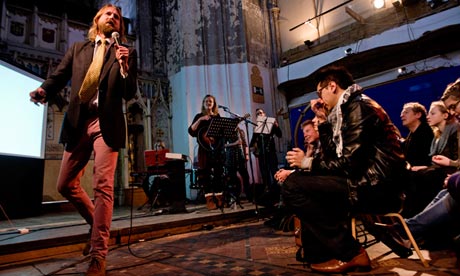
I was interested to read this article in the British newspaper The Guardian about an atheist church service in London. Atheists want community and something to do on a Sunday morning. After experiencing the service, a couple of curious atheists from High Wycombe told the reporter:
"Some of the things I thought really wouldn't work, like the singing, were really good. Normally I hate singing." Churches do a lot of what they do "because it works", he notes, "Atheists make a mistake to look at church and throw it all out just because they don't believe in God."
And what did they sing together? "Don't Stop Me Now" by Queen and "Superstition" by Stevie Wonder.